What Is a Website Marketing Audit — and What Should It Actually Check?
A website can load quickly, look polished and have correct metadata while still making it hard for visitors to understand the offer, trust the business or choose a sensible next step. A website marketing audit looks beyond isolated technical or visual issues to evaluate whether the site supports real business decisions.
The term “website audit” can mean many things. A business may receive a long report on performance or SEO and still not know whether its website explains what it does, guides the right audience or supports meaningful action.

Website marketing audit: a working definition
A website marketing audit is a structured evaluation of whether a website helps its intended visitors understand, trust and act on the business's offer-and whether its content, journeys and technical foundation support those decisions.
It does not audit every part of a company's marketing. It evaluates the website as a marketing and decision-support system: what the site communicates, how visitors move through it, what evidence supports its claims and whether the experience works reliably enough to support those choices.
A healthy website is not necessarily an effective one
Consider a B2B service company. Its website is fast, indexed and professionally designed. Yet its headline describes "transformative growth" rather than a clear offer. Its consulting, implementation and training services receive equal attention, despite serving different needs. Case studies praise the team's responsiveness but do not support the site's promise of measurable operational improvement.
The main service CTA opens a generic contact page. The form asks for a detailed brief before the company has explained its process. Analytics records page views but not form starts or successful submissions.
A technical review might identify no serious defects. A visual review might find the page credible. But a website effectiveness audit would reveal a connected problem: the site gives relevant prospects too little help to understand, compare and continue.
| Audit type | Primary focus |
|---|---|
| Technical SEO audit | Crawlability, indexability and search-related technical health |
| UX audit | Usability, accessibility and interaction quality |
| CRO audit | Conversion performance and experimentation opportunities |
| Website marketing audit | Alignment between business meaning, visitor decisions, journeys and supporting foundations |
A marketing website audit does not replace these specialist reviews. It connects their findings where they affect the website's role in marketing.
The audit map: four lenses, one system
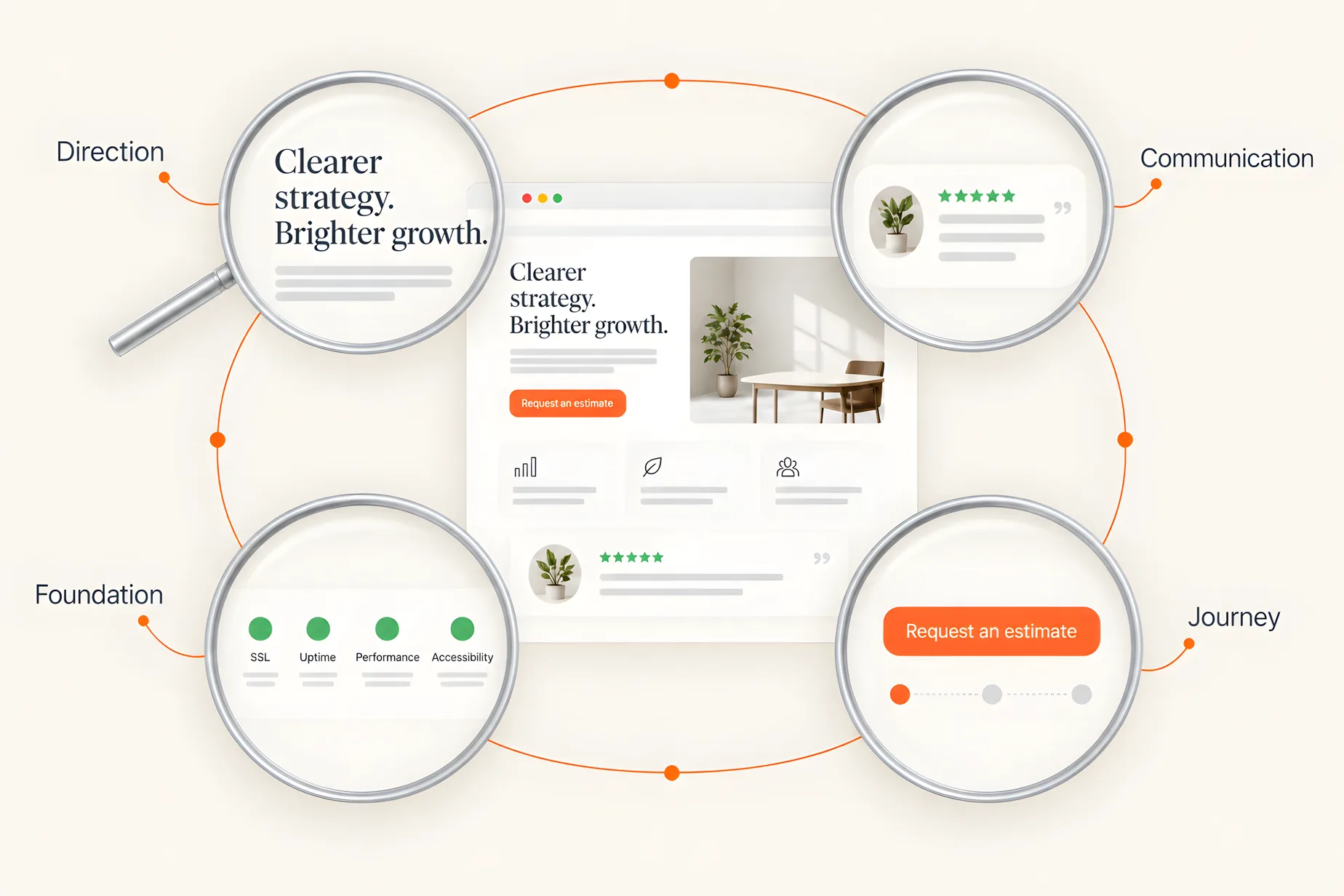
A useful website audit methodology considers four connected lenses. They are not separate website audit categories to score independently: a problem in one lens often appears because of a weak relationship between several of them.
Lens one: Direction
Question:
Does the site appear to support a clear business role for a recognisable audience?
This lens examines the role of the website, the audiences it serves, positioning, offer hierarchy and relevant pricing or process context. A business can have several services and audiences, but visitors should be able to understand how those options relate and where they fit.
In the B2B example, consulting, implementation and training appear as equal offers with no explanation of who needs which one. The site may be reflecting a real business strategy-but a site-only review cannot confirm that without internal context. It can observe that the current presentation makes the relationship unclear.
Homepage Audit Checklist - assess whether the homepage explains and routes the business
Lens two: Communication
Question:
Can visitors understand the offer, judge its relevance and find credible support for important claims?
This includes message clarity, content hierarchy, terminology, visual meaning, evidence, trust signals and content consistency. A claim without relevant proof is not only a copy issue; it is also a trust issue. A visual that suggests a different offer can weaken positioning as well as design coherence.
For the B2B company, a testimonial about "excellent communication" does not substantiate a claim about operational results. The finding is not that the testimonial is bad. It is that the evidence and the promise do not match.
Hero Section Checklist - review first-screen clarity
Website Trust Signals - assess evidence behind key claims
Does Your Website Look AI-Generated? - test for genericity risk
Lens three: Journey
Question:
Can visitors find the right information and complete a relevant next step without losing context?
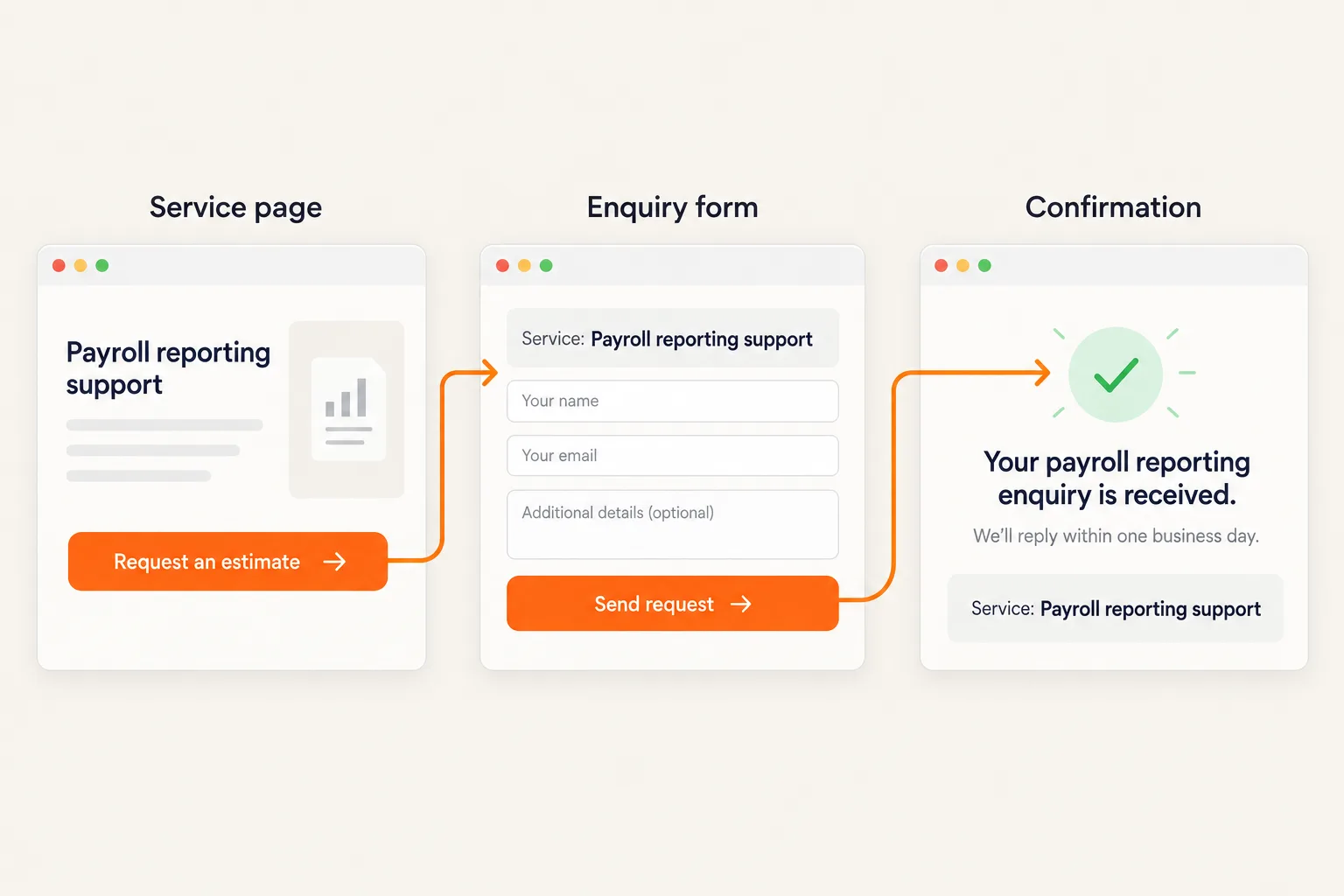
A journey includes navigation, page relationships, CTA hierarchy, message continuity, forms, error recovery, confirmation states and mobile interaction. A button is not the end of the analysis; the destination and what follows matter too.
In the example, a visitor chooses a specific service, then arrives at a generic contact form and must select a category again. The site has discarded context the visitor already supplied through their path.
Website CTA Checklist - review the hierarchy and clarity of actions
Contact Form Audit - examine form friction and uncertainty
Conversion Path Audit - trace continuity after a CTA click
Lens four: Foundation and measurement
Question:
Does the underlying website reliably support discovery, use and evaluation?
This lens covers technical integrity, performance, mobile behaviour, basic search readiness, broken links, assets, privacy cues and measurement readiness. It is not a full technical SEO or security audit.
Foundation affects the other lenses. A broken CTA is both a technical problem and a journey problem. A working form that does not record a conversion event is a measurement failure: leads may arrive, but the business cannot evaluate that action accurately.
The most useful findings sit between the lenses
Many website issues are not confined to one discipline:
| Pattern | Connected lenses |
|---|---|
| A strong CTA appears beside insufficient evidence | Communication + journey |
| A clear offer leads to a generic destination | Direction + journey |
| Relevant content has no sensible next step | Communication + journey |
| A fast mobile page contains an inaccessible interaction | Journey + foundation |
| A form works, but key actions are not tracked | Journey + measurement |
This is why a marketing website analysis should not treat page sections as disconnected parts. It asks whether the site's message, evidence and paths reinforce one another.
If results remain unclear after narrow audits, broader context can be useful. A site can receive traffic but still fail to give visitors enough decision information; it can also have a sound website experience while attracting mismatched traffic.
Why Is My Website Not Converting? - investigate broader website-performance signals
Website Traffic but No Leads? - separate traffic questions from site evidence
State what the site shows, then label the leap
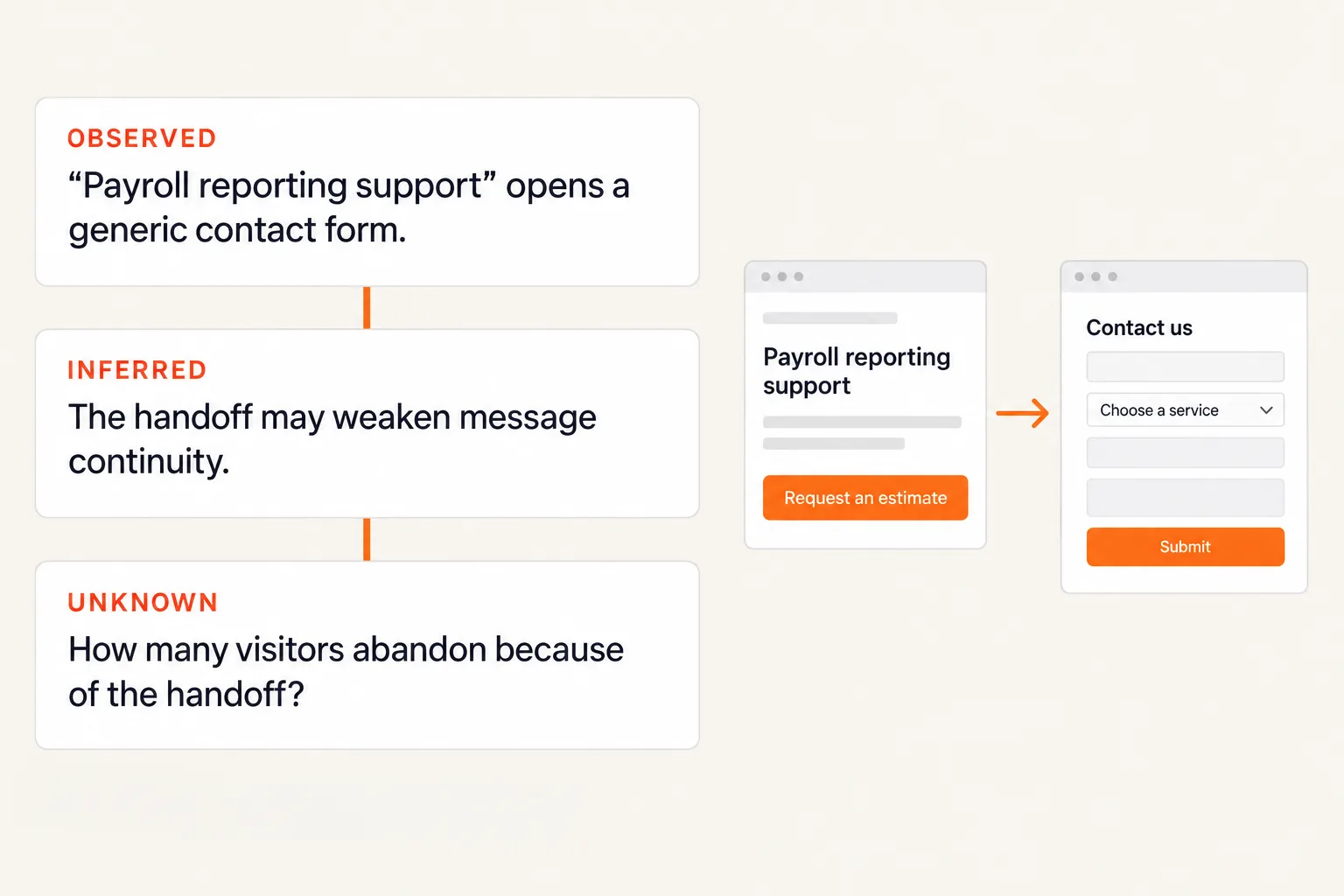
A credible audit distinguishes direct evidence from interpretation and from questions the website alone cannot answer.
| Level | Meaning | Example |
|---|---|---|
| Observed | Directly present or reproducible | A service CTA opens a generic contact form |
| Inferred | A supported interpretation of the evidence | The handoff may weaken message continuity |
| Unknown | Requires outside context or data | How many visitors abandon because of the handoff |
A site review can identify visible claims, navigation labels, form fields, destinations, page structure and reproducible errors. It can infer potential uncertainty or conflicting signals. It cannot prove visitor motivation, product-market fit, traffic quality, profitability or the exact cause of a conversion decline without additional evidence.
What an evidence-backed audit finding looks like
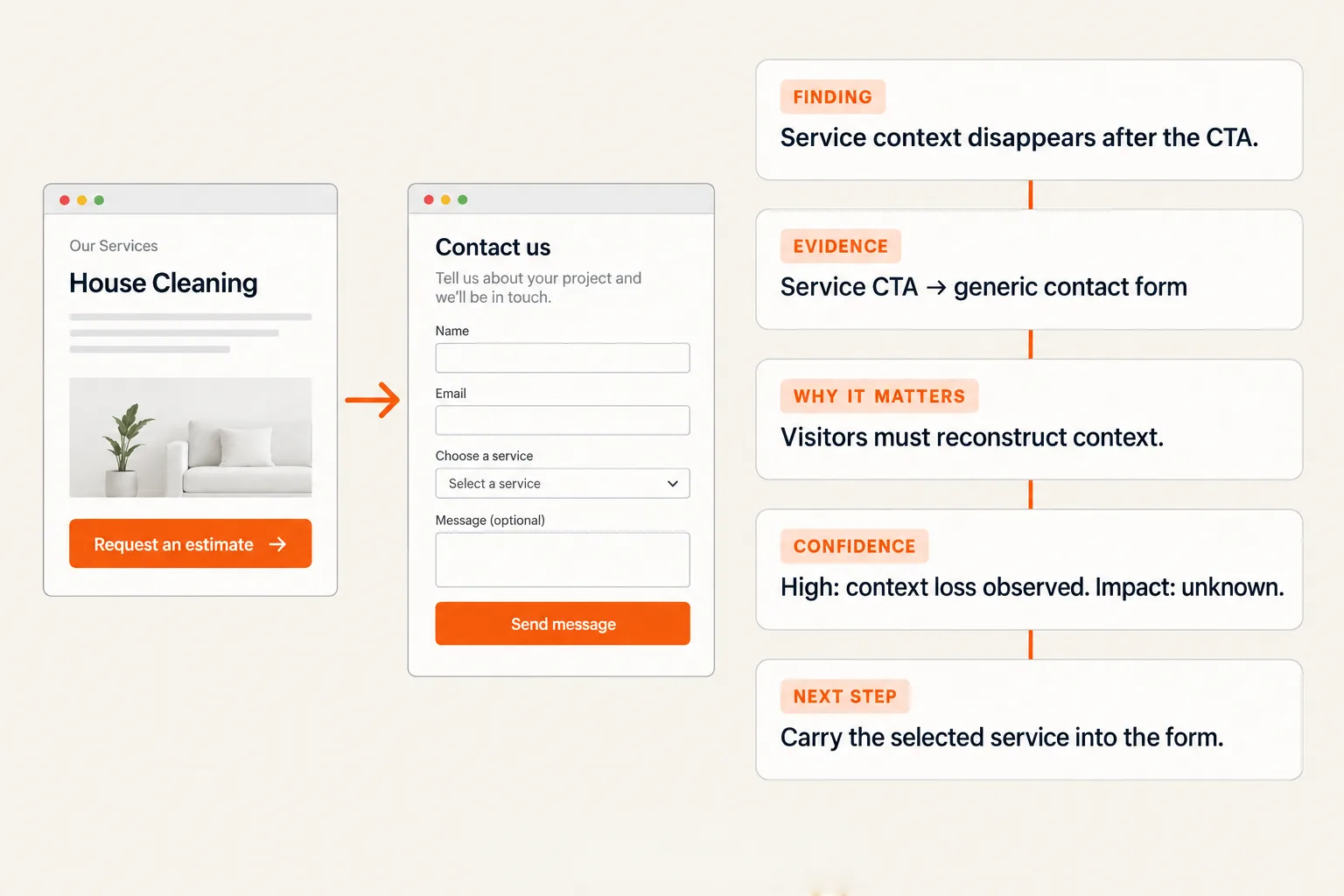
Example: service context disappears after the CTA
Finding: The "Request an estimate" CTA opens a generic contact form and does not preserve the selected service.
Evidence: The service-page CTA, its destination URL, the generic form heading and a repeated service-selection field.
Why it matters: Visitors must reconstruct context that the previous page already established. This may create unnecessary uncertainty at a high-intent moment.
Confidence: High for the observed context loss; unknown for its conversion impact.
Recommended action: Carry the selected service into the form and maintain the same wording through confirmation.
Validation: Compare form starts, completions and lead quality after implementation.
A useful finding is specific, scoped, actionable and honest about uncertainty. It should help a team decide what to change and how to verify the result.
A long checklist is not the same as an audit
A marketing website audit checklist is useful for baseline coverage: are links working, is mobile content readable, does the form show an error state?
An audit goes further. It considers whether a rule applies to this business, how an element relates to other elements, whether an issue is local or systemic and what information is missing before a claim can be made confidently.
That difference matters when teams need more than a list of fixes. They need a shared view of dependencies, evidence and business relevance.
Prioritise by decision impact, not page aesthetics
A good audit report does not rely on an artificial website score. It weighs five practical factors:
- Severity: Does the issue block understanding or action?
- Reach: How many important pages or journeys are affected?
- Confidence: How well does the evidence support the finding?
- Dependency: Must this be fixed before other changes can work?
- Effort and risk: How difficult is implementation and validation?
Start with broken, misleading or irreversible paths. Then address problems that prevent visitors from understanding the offer or completing a primary action. Missing material evidence and systemic structural issues usually come next. Local copy, visual and interaction refinements can follow.
Hypotheses that require analytics, customer research or testing should remain clearly labelled-not promoted above observable blockers.
When a website marketing audit is useful
A business website audit is especially useful before a redesign, after a change in positioning or offers, before scaling paid traffic, after a significant performance change or when several teams are making uncoordinated site decisions.
It can also help when a business has completed technical or visual reviews but still lacks a clear picture of how the website supports marketing.
If the problem is already known and purely technical, a specialist investigation may be the faster route.
What the final report should help you decide
A useful website audit report should make it easier to answer:
- What is actually broken, and what only needs validation?
- Which pages and journeys are affected?
- What should be fixed first?
- Which changes depend on other changes?
- What can improve without a full redesign?
- Which questions require analytics, research or experimentation?
- How will the team check whether a change helped?
The value of a comprehensive website audit is not the number of issues it finds. It is the quality of the next decisions it supports.
More than a website health check
A website is a system of connected decisions. It communicates a business proposition, helps visitors judge relevance, offers evidence, routes people to useful information and relies on technical foundations to make those steps possible.
A technically healthy site can still be marketing-weak. A visually strong site can still create friction. A valuable website marketing audit shows the evidence behind those distinctions, states where certainty ends and turns findings into a practical order of work. That is more useful than a generic health score-and more honest than claiming a site review can explain every business outcome.
Questions businesses ask before a website marketing audit
What does a website marketing audit include?
It evaluates the relationship between business direction, audience and offer clarity, messaging, trust, visitor journeys, usability, technical integrity, search readiness and measurement. The exact scope should reflect the website's purpose.
Is a website marketing audit the same as an SEO audit?
No. An SEO audit focuses on search visibility and technical search health. A website marketing audit includes those foundations where relevant, but also examines how the site communicates, builds trust and supports visitor decisions.
Can a website be audited without analytics access?
Yes. A site-only review can identify observable evidence and form limited hypotheses. Analytics helps assess reach and measured behaviour, but it does not automatically prove why visitors act or leave.
Do I need a full redesign after a website audit?
Usually not. An audit should first establish whether the problems are local, systemic or dependent on business strategy. Message hierarchy, navigation labels, evidence and journey continuity can often improve without rebuilding the entire site.