10 Best AI Automation Agency Webflow Templates for 2026
The best AI automation agency Webflow template depends on what you sell and how much proof your website needs. Automately is our top choice for a complete, focused agency website; Melville offers the largest content system; NextAI is the strongest multi-layout option with ecommerce; and Bima is a practical choice for a smaller, faster launch.
This guide compares ten real Webflow Marketplace templates for AI automation agencies, AI consultants, no-code studios and workflow specialists. We reviewed their page structures, CMS support, positioning, design style and ability to move a buyer from “What does this agency do?” to “I’m ready to enquire.”

Quick answer: which template is best for you?
- Best complete multi-page system: Automately
- Best for the largest content operation: Melville
- Best multi-layout and ecommerce option: NextAI
- Best dark automation-specific design: Automora
- Best for established AI consulting firms: Consult AI
- Best compact automation agency website: Bima
- Best light and approachable design: Sadewa
- Best focused B2B implementation site: Clavion
- Best for AI strategy and research consultancies: Intellect
- Best for agencies that also sell products: NexFlow
Quick comparison
Automately
- Price
- $99
- Pages
- 16
- CMS
- 3 collections
- Style
- Clean, modern, conversion-focused
- Best for
- Complete service-based agency website
Melville
- Price
- $129
- Pages
- 44 listed
- CMS
- 7 listed collections
- Style
- Premium, modern, multi-layout
- Best for
- Large agencies needing maximum flexibility
NextAI
- Price
- $129
- Pages
- 29 core pages
- CMS
- 4 collections
- Style
- Dark, modern, multi-layout
- Best for
- Agencies combining services, content and ecommerce
Automora
- Price
- $79
- Pages
- 16 listed
- CMS
- 3 collections
- Style
- Bold, dark, automation-specific
- Best for
- Workflow, chatbot and AI agent agencies
Consult AI
- Price
- $129
- Pages
- 24 listed
- CMS
- 3 collections + ecommerce
- Style
- Modern, corporate, minimal
- Best for
- Corporate AI consulting firms
Bima
- Price
- $99
- Pages
- 6
- CMS
- 2 confirmed collections
- Style
- Dark, modern, compact
- Best for
- Lean agencies that need proof and a blog
Sadewa
- Price
- $99
- Pages
- 12
- CMS
- 2 confirmed collections
- Style
- Light, corporate, playful
- Best for
- Approachable AI agencies and early-stage teams
Clavion
- Price
- $79
- Pages
- 12
- CMS
- 2 content types listed
- Style
- Bold, dark, technical
- Best for
- B2B AI implementation and systems firms
Intellect
- Price
- $99
- Pages
- Not stated
- CMS
- 4 content areas listed
- Style
- Bold, dark, consulting-led
- Best for
- AI strategy, research and advisory teams
NexFlow
- Price
- $79
- Pages
- 18
- CMS
- CMS + ecommerce
- Style
- Dark, corporate, clean
- Best for
- AI agencies that also sell digital products
What an AI automation agency website needs
An AI agency website has a harder job than a typical creative-agency site. Prospective clients may know that they want automation, but they often cannot define the system, scope or expected return yet. The website must make a complex service feel concrete without reducing it to vague claims about “transforming the future.”
Clear service pages
Your website should separate offers such as AI workflow automation, AI agents, CRM automation, chatbot development, internal knowledge systems and custom integrations. A dedicated page for each core service gives buyers enough detail to self-qualify and gives search engines a clear page to rank for a specific problem.
Use cases tied to business problems
Visitors rarely buy “AI” in isolation. They buy faster lead handling, fewer repetitive tasks, better customer support or more reliable reporting. Strong use-case sections connect each technical capability to a team, workflow and measurable outcome.
Case studies with evidence
AI automation involves access to business data, existing systems and operational processes. Buyers need proof that an agency can deliver safely and reliably. A useful case study explains the original workflow, the implemented system, the tools involved and the result — not just a logo and a short testimonial.
A visible delivery process
A clear process reduces perceived risk. At minimum, explain discovery, workflow mapping, solution design, implementation, testing and ongoing optimization. If your projects vary significantly, show what happens before a proposal and what happens after approval.
Pricing or engagement guidance
You do not need to publish a fixed price for every custom project. However, a starting price, typical engagement range or comparison of packages helps buyers understand whether the agency is relevant to their budget.
Insights and educational content
A CMS-powered blog can support organic discovery while demonstrating expertise. The strongest content answers the questions buyers ask before contacting an agency: what to automate first, how much a project costs, where AI agents fail and how to measure ROI.
A low-friction enquiry flow
The primary CTA should make the next step obvious: book a discovery call, request an automation audit or submit a project enquiry. The form should collect enough information to qualify the lead without turning the first contact into a full technical brief.
How we evaluated the templates
We reviewed each template against six practical criteria:
- Relevance: Is the structure genuinely useful for an AI automation or consulting agency, rather than simply using an AI visual style?
- Buyer journey: Does the site explain services, process, proof and the next step clearly?
- Content depth: Are there enough pages for services, case studies, insights, pricing and trust-building content?
- CMS scalability: Can the team add new services, projects and articles without rebuilding page layouts?
- Customization: Are styles, reusable components and layouts organized for adaptation to a real brand?
- Scope and value: Does the page system justify the price without adding unnecessary complexity?
We did not rank templates by marketplace sales or conversion rates because comparable public data is not available. The order reflects suitability for an AI automation service business, not simply the number of included pages.
The 10 best AI automation agency Webflow templates
01Automately — best complete multi-page system
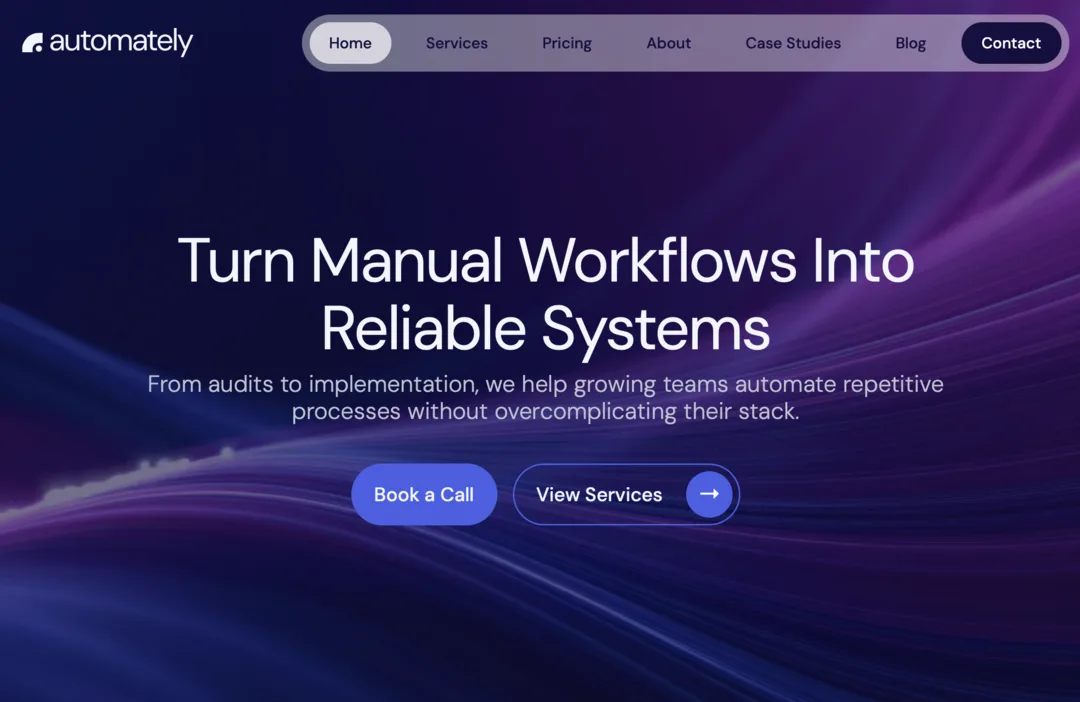
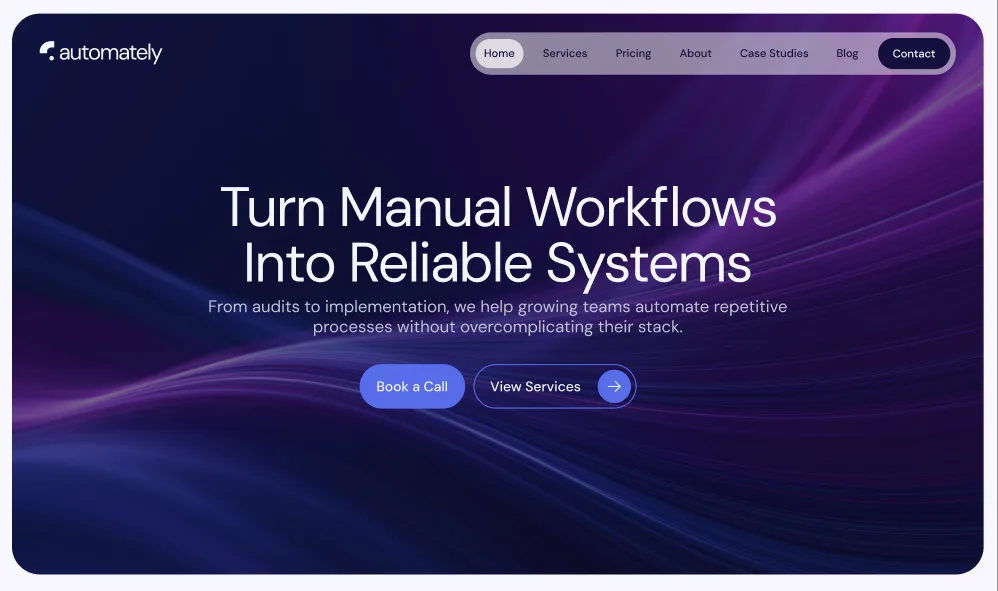
Automately is designed specifically for AI automation studios, no-code agencies and workflow consultants that need more than a polished landing page. Its 16-page structure covers the full service-business buyer journey: services, pricing, case studies, blog content, About, FAQ, contact and supporting utility pages.
The three CMS collections — Services, Case Studies and Blog Posts — are the main reason we rank it first. They correspond directly to the content an expertise-led agency needs to grow: what you sell, evidence that it works and insights that attract future buyers. The structure stays focused on lead generation rather than adding ecommerce or user-account pages that many agencies will never use.
Strengths
- Complete service, pricing, proof, content and enquiry structure
- Dedicated CMS collections for services, case studies and articles
- Conversion-focused page hierarchy and repeated enquiry paths
- Global styles, a complete Style Guide and organized reusable classes
- Responsive layouts, semantic foundation and GSAP interactions
Limitations
- It does not include ecommerce or account pages
- It offers less layout variation than larger multi-layout templates
- Agencies with several distinct divisions may need additional top-level pages
Best for:
AI automation agencies, no-code studios, workflow consultants and small-to-mid-sized implementation teams that want a complete website without unnecessary platform features.
02Melville — best for the largest content operation
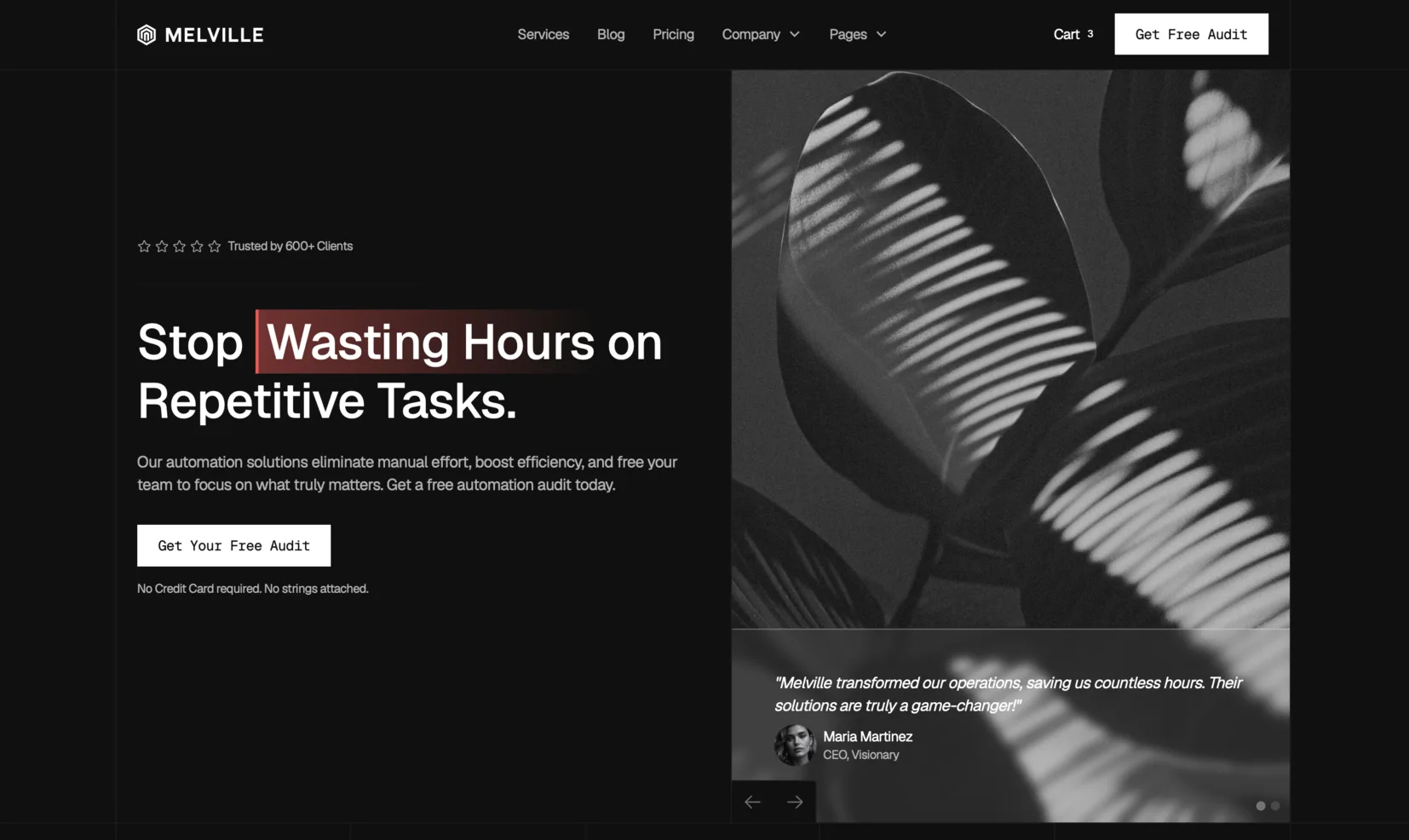
Melville is the most expansive option in this comparison. Its current listing contains 44 named pages, multiple versions of home, services and blog layouts, ecommerce, account screens, pricing variants, search, waitlist and a large supporting design system.
That breadth makes Melville suitable for an agency with several offers, a content team or plans to sell packaged services. It also gives experienced Webflow users more layouts to combine. The tradeoff is setup time: a smaller agency may spend more time removing unused functionality and deciding between variations.
Strengths
- Largest page system in this comparison
- Multiple home, service, blog and contact layouts
- CMS, ecommerce, account and search functionality
- Detailed design system, variables, components and documentation
- Recent additions include waitlist and AI-assisted content guidance
Limitations
- More complex than most small agencies need
- Ecommerce and account functionality may be unnecessary
- The listing currently contains conflicting references to six and seven CMS collections, so verify the final structure before buying
Best for:
Established automation agencies, AI/ML consultancies and digital-transformation firms with multiple services, frequent content publishing or packaged offers.
03NextAI — best multi-layout and ecommerce option
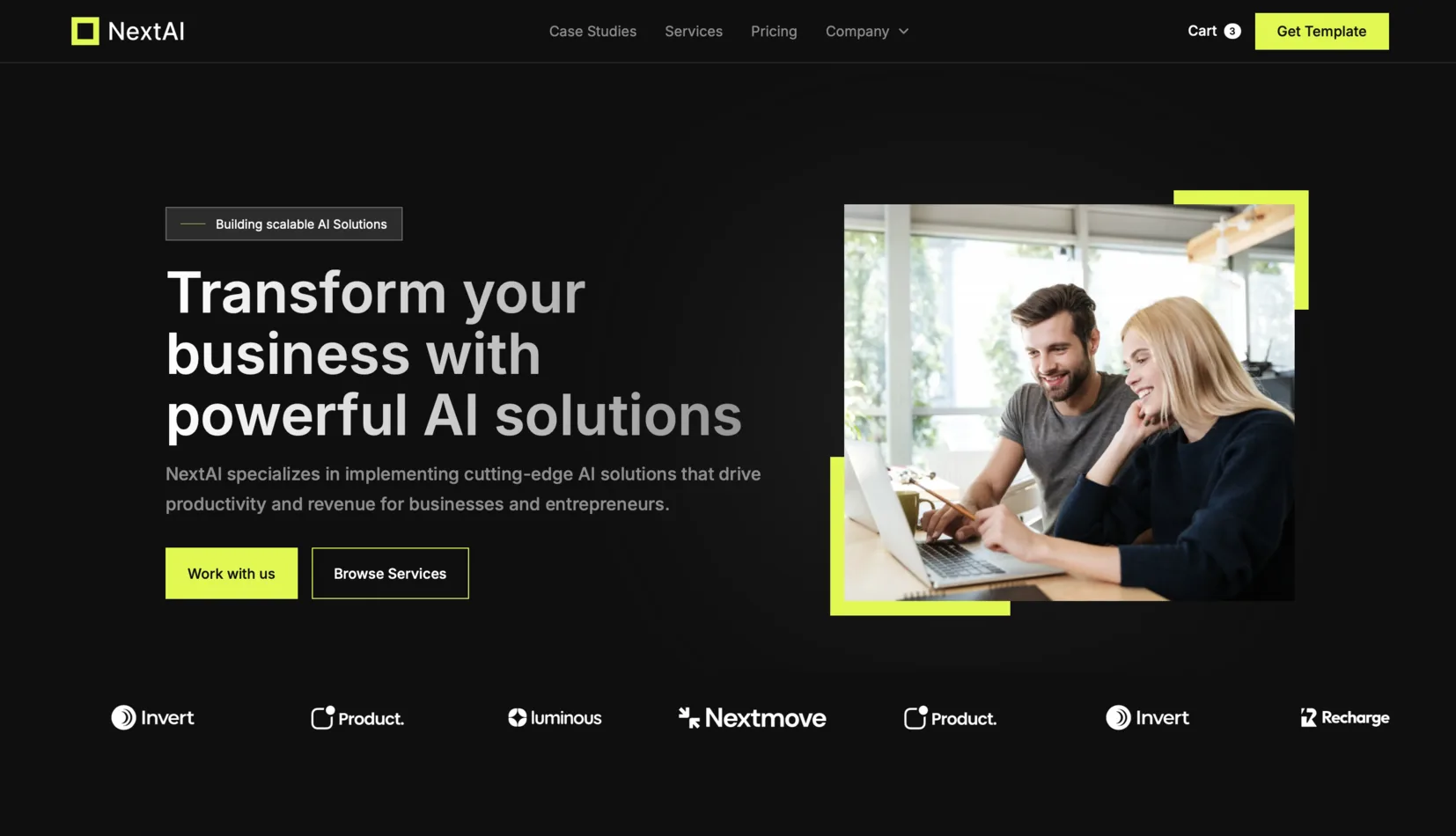
NextAI combines 29 core pages, three homepage variations, three service layouts, three blog layouts, case studies, pricing, ecommerce and four CMS collections. It is a flexible system for agencies that want to test different positioning or combine consulting with digital products.
Its strongest advantage is choice. Teams can select a homepage and service structure that matches their sales model instead of redesigning the original composition. However, the broad feature set also makes it less focused than a dedicated service-only system.
Strengths
- Three homepage, service and blog variations
- Case studies, pricing, careers and team content
- Four CMS collections
- Full ecommerce and account-page support
- Detailed Start Here and Style Guide pages
Limitations
- Higher price than focused multi-page alternatives
- Ecommerce and account pages can add unnecessary complexity
- The positioning is broader AI consulting, so automation specialists will need to sharpen the copy and use cases
Best for:
AI consultancies and automation agencies that need multiple layout options, publish frequently or plan to sell products or packaged services.
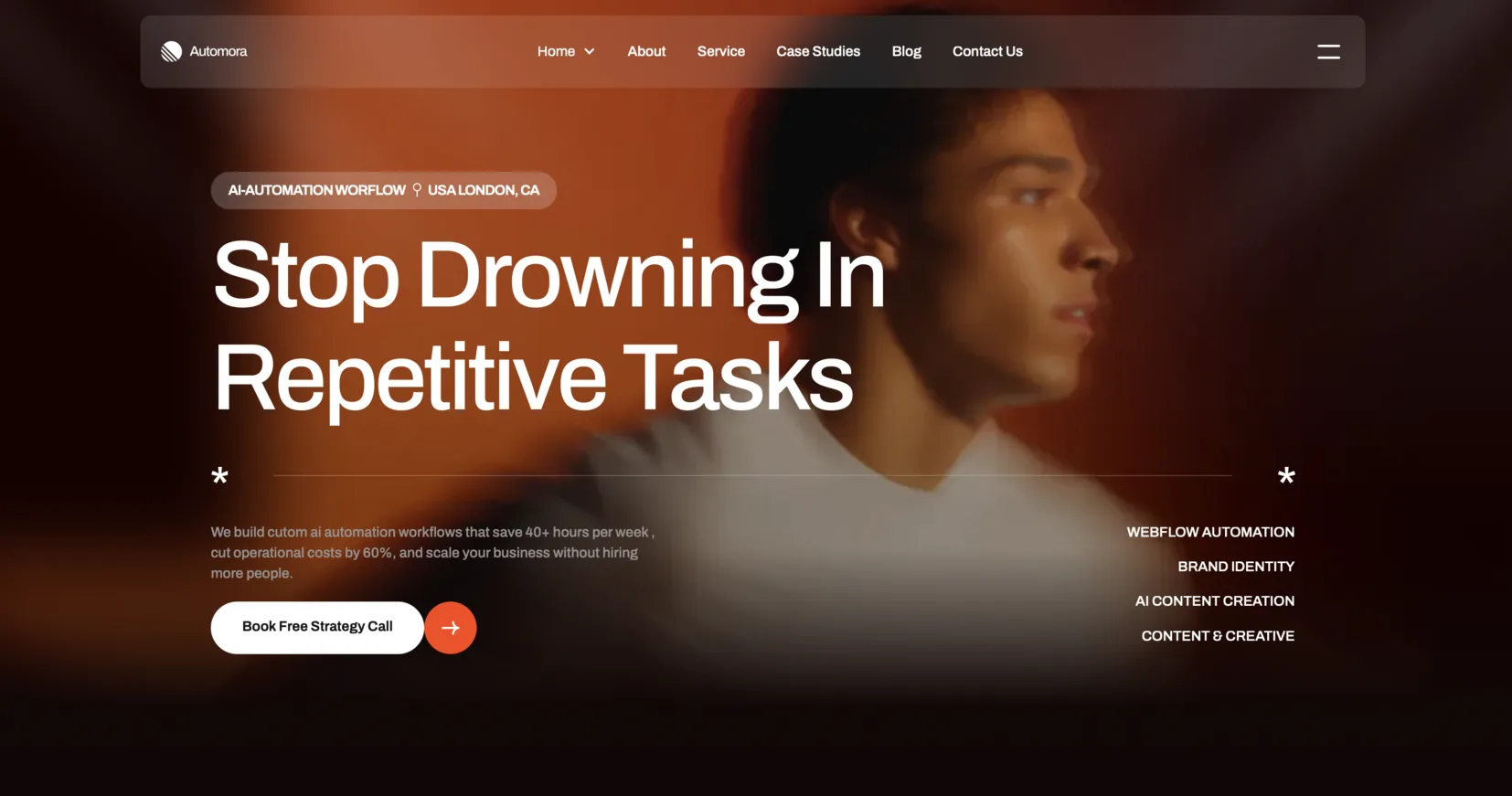
04Automora — best dark automation-specific design
Automora is one of the most explicitly automation-focused templates in the list. Its sample structure covers AI workflows, chatbots, voice agents, CRM automation, process, industries, pricing, case studies and strategy-call CTAs. The 16 listed pages include two homepages and CMS templates for services, case studies and blog posts.
The template is a strong choice if its bold dark direction already fits your brand. It also includes a Figma source file on request, notification bars, an email signature and social assets. Those extras are useful, although the visual system is distinctive enough that moving to a light or restrained corporate brand may require more work.
Strengths
- Highly relevant automation-specific content structure
- Two homepages and more than 30 reusable sections
- CMS for services, case studies and blog content
- Pricing, industries, process, FAQ and lead-generation sections
- Figma source and supporting brand assets available
Limitations
- The bold dark aesthetic will not suit every B2B audience
- Fewer pages and layout variations than Melville or NextAI
- Some included promotional assets may not matter to agencies focused only on the website
Best for:
AI agent, chatbot, voice-agent and workflow-automation agencies that want a bold technical presence.
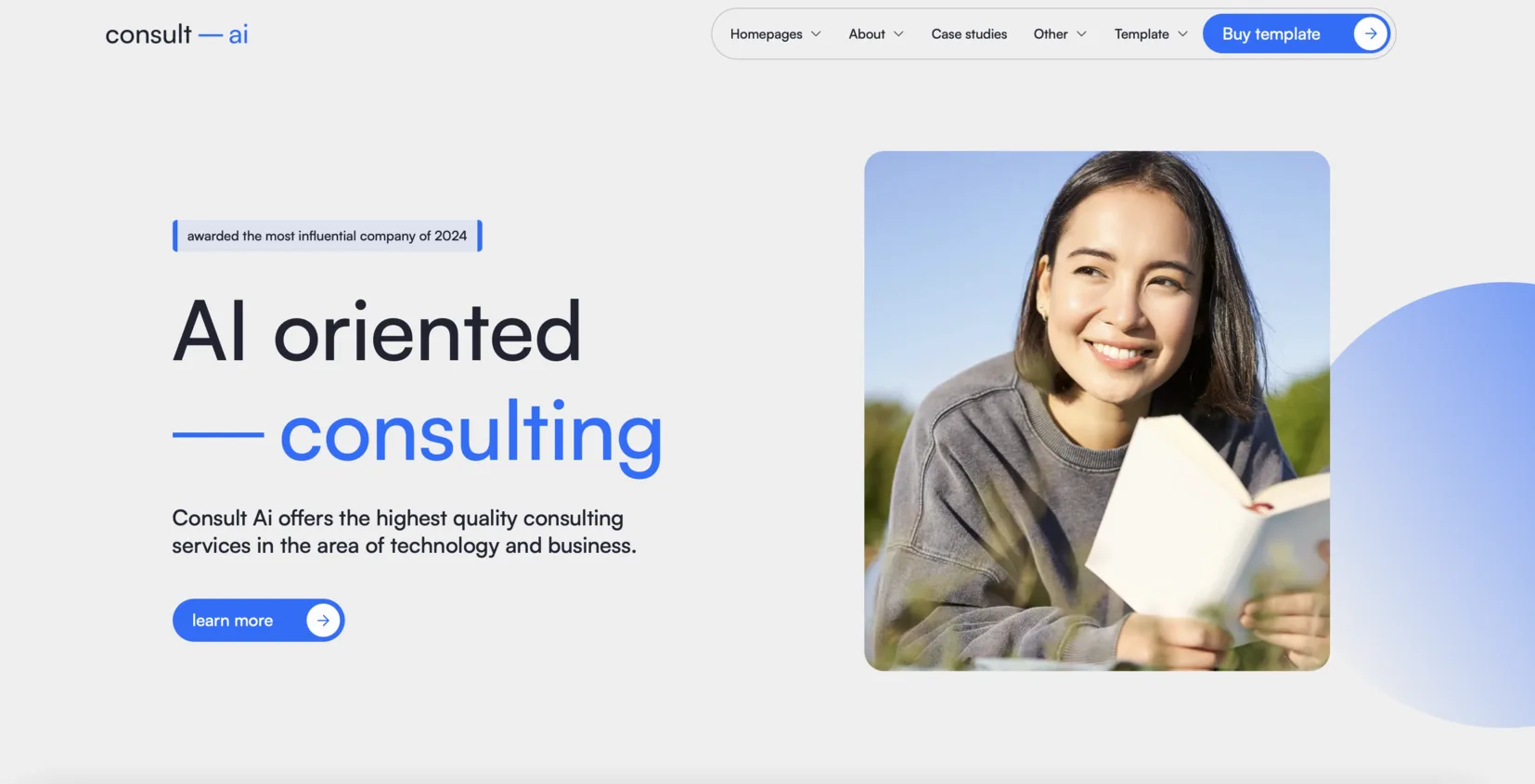
05Consult AI — best for established AI consulting firms
Consult AI takes a more traditional consulting approach. It includes three homepage, About and contact variants, plus CMS-powered case studies, careers and blog content. Ecommerce is also configured for firms that want to sell services or packages directly.
The visual direction is professional and less dependent on futuristic AI effects, which can work well for strategy, governance and enterprise advisory firms. The main structural gap for an automation agency is the lack of a clearly listed dedicated services page; most teams will need to create one from existing sections.
Strengths
- Strong corporate credibility and restrained visual language
- Multiple versions of key pages
- Case studies, careers and blog CMS collections
- Ecommerce setup and an available Figma file
- Modular sections and reusable animations
Limitations
- No dedicated services page is listed
- Less specific to workflow automation and AI implementation
- Larger price and feature set than many smaller consultancies need
Best for:
AI strategy consultancies, enterprise advisory firms and established professional-services teams.
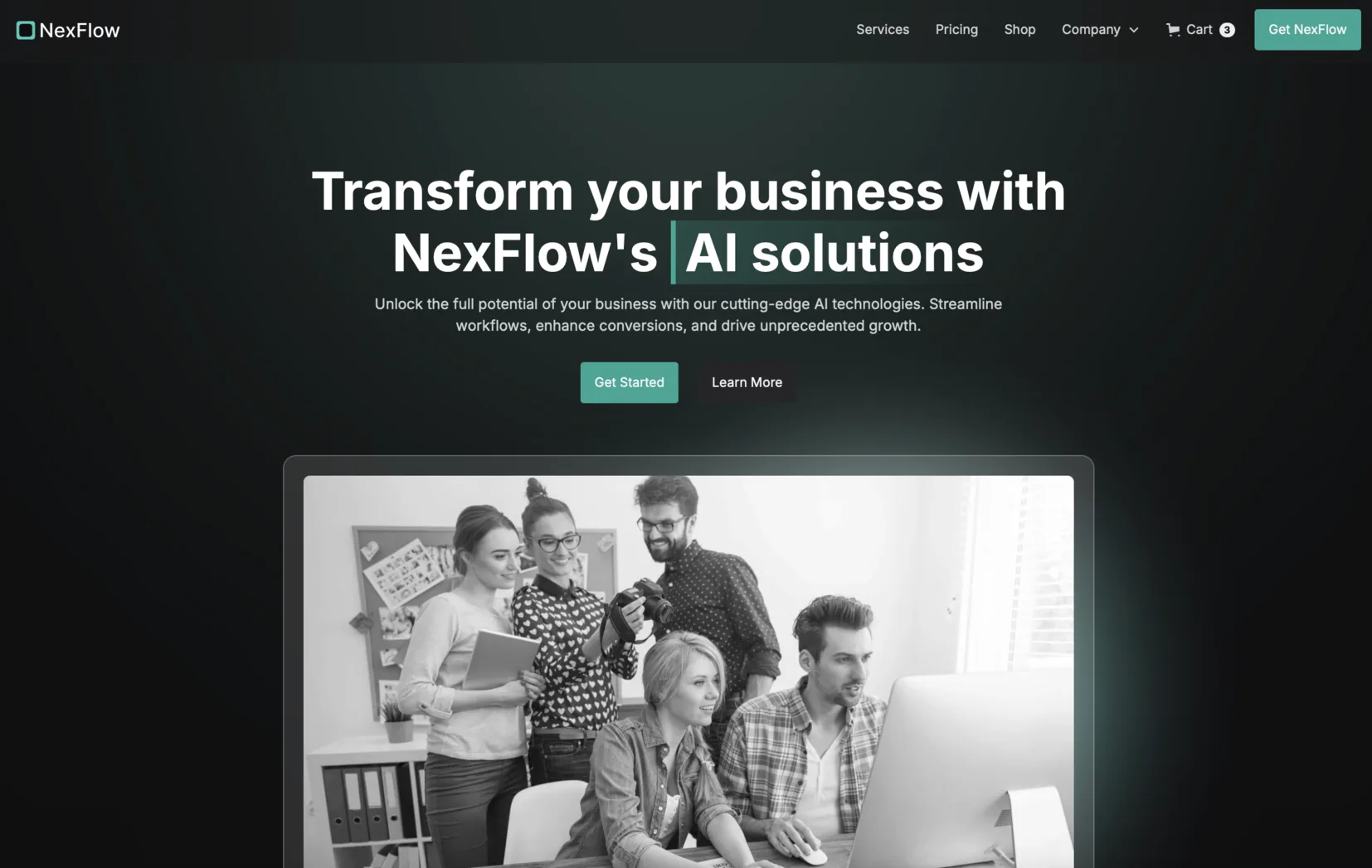
06NexFlow — best for agencies that also sell products
NexFlow is an 18-page dark template positioned for AI agencies, marketers and technology businesses. It includes CMS support for blog content and categories, plus ecommerce pages for physical or digital products.
It is a useful hybrid when an agency sells audits, templates, training or other productized resources alongside services. For a pure implementation agency, however, the shop receives space that might be better allocated to use cases, delivery process and detailed project proof.
Strengths
- 18 responsive pages
- CMS-powered blog structure
- Ecommerce for digital or physical products
- Reusable components and fluid animations
- Clean dark presentation
Limitations
- Less automation-specific than the top options
- Ecommerce may distract from a consultative sales journey
- The listing emphasizes blog and product content more than service or case-study CMS depth
Best for:
AI agencies that combine consulting with digital products, templates, courses or packaged resources.
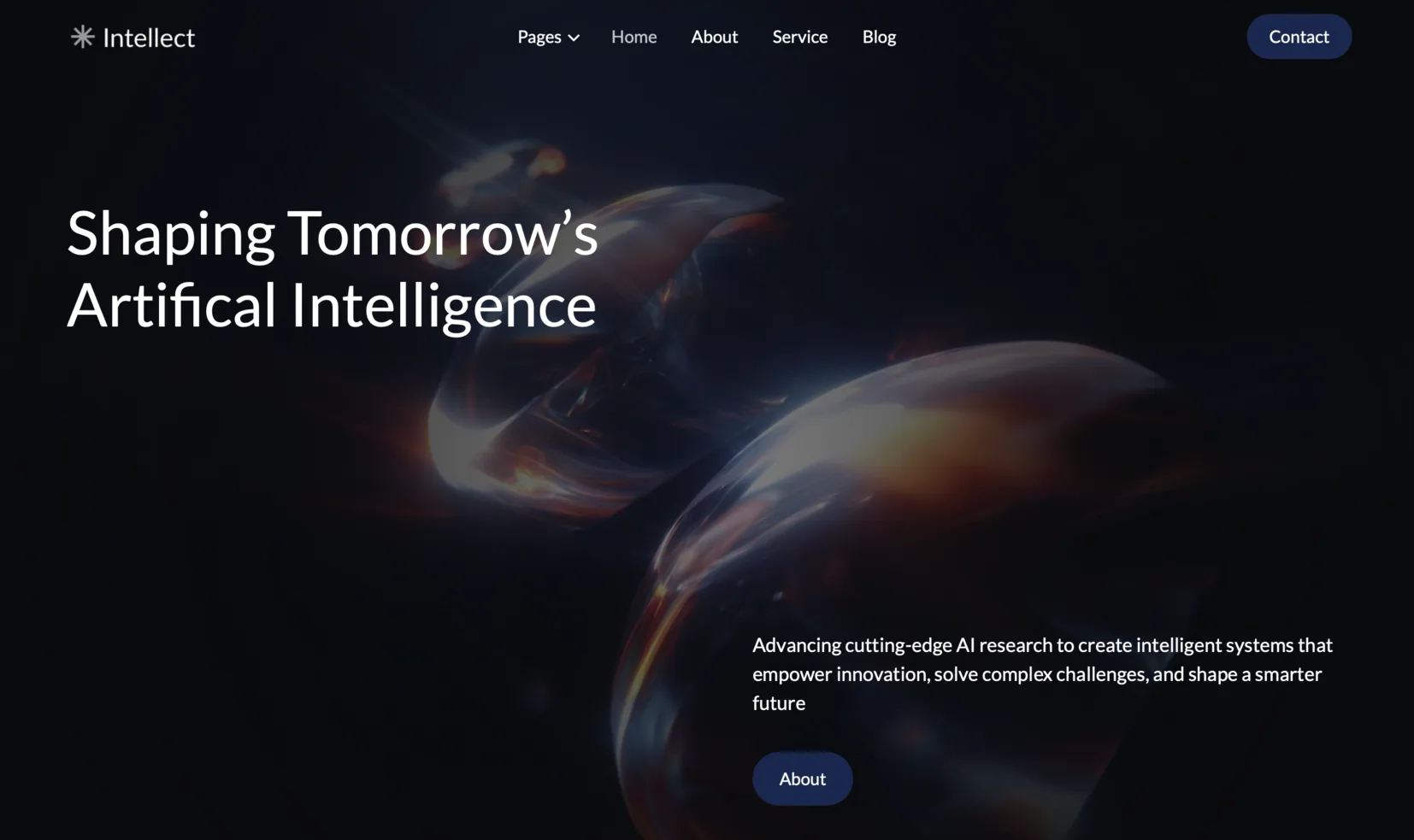
07Intellect — best for AI strategy and research consultancies
Intellect is positioned around AI consulting, research, data-driven strategy and technology advisory. It offers three homepage designs, three blog layouts, three contact layouts and CMS content areas for articles, customer stories, careers and team members.
This makes it better suited to an expertise-led consultancy than a tactical no-code studio. It can support thought leadership and team credibility well, but automation agencies will need to add clearer workflow, integration and implementation content.
Strengths
- Strong fit for advisory and research-led positioning
- Multiple home, blog and contact layouts
- CMS areas for insights, customers, careers and team members
- Figma source available after purchase
- Webflow variables for faster global styling
Limitations
- The listing does not state a total page count
- More consulting-focused than automation-specific
- Pricing, service-detail and delivery-process needs may require additional work
Best for:
AI strategy firms, research consultancies, technical advisors and data-focused professional services.
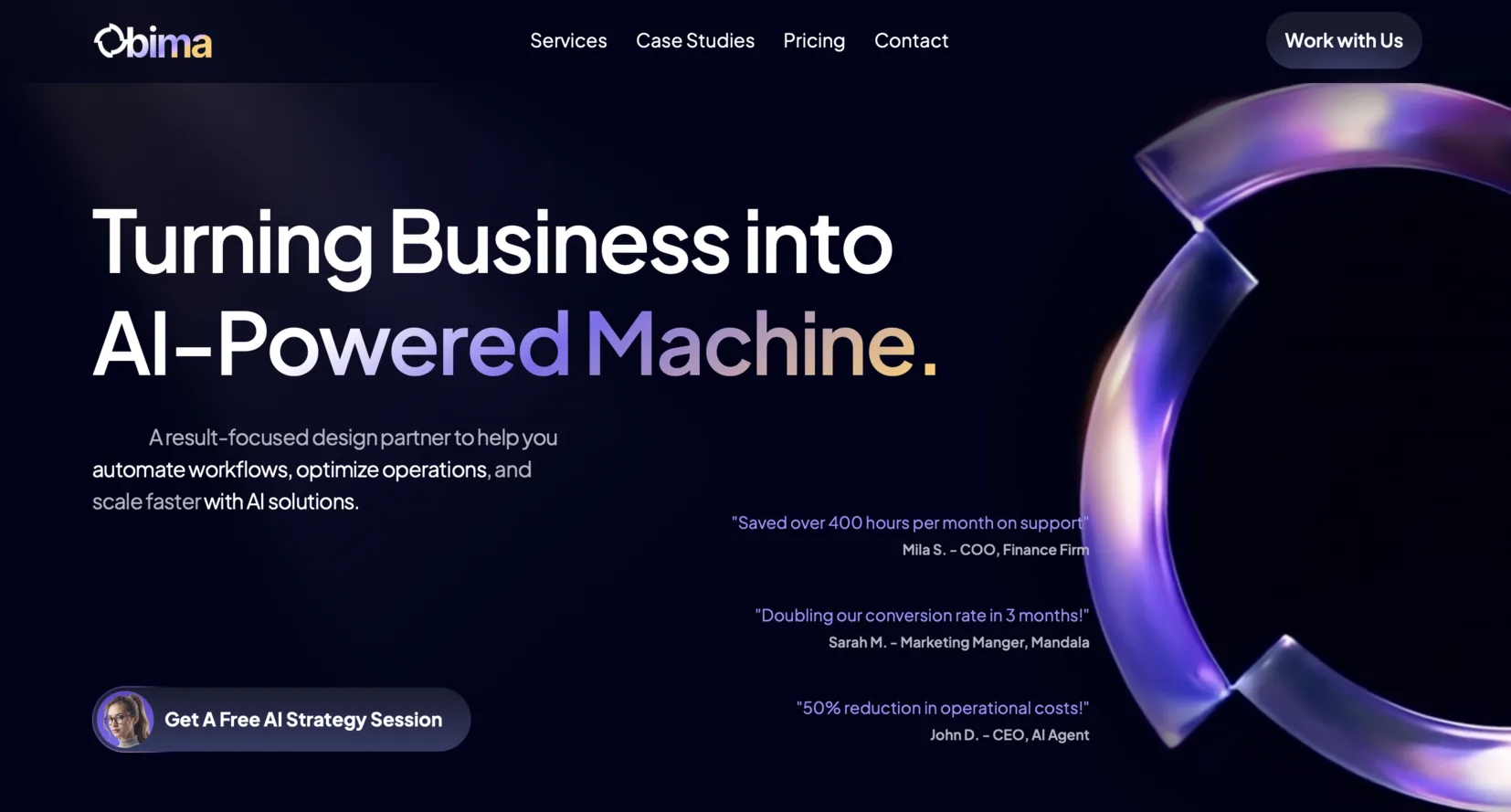
08Bima — best compact automation agency website
Bima is a compact six-page template with Home, case studies, a CMS case-study detail page, blog, CMS blog detail and 404. Its smaller scope is the point: it gives a lean agency a polished site with proof and content without asking the team to populate a large navigation from day one.
The limitation is equally clear. There are no separate About, contact, services or pricing pages in the listed structure. Those sections will need to live on the homepage or be added later.
Strengths
- Compact structure that can be launched quickly
- Case studies and blog content are included
- Modern dark visual direction
- Clear fit for AI automation agencies and B2B services
Limitations
- Only six listed pages
- No dedicated services, About, contact or pricing pages
- Limited room for a complex service architecture
Best for:
Solo consultants and small AI automation agencies with a focused offer and a limited amount of launch content.
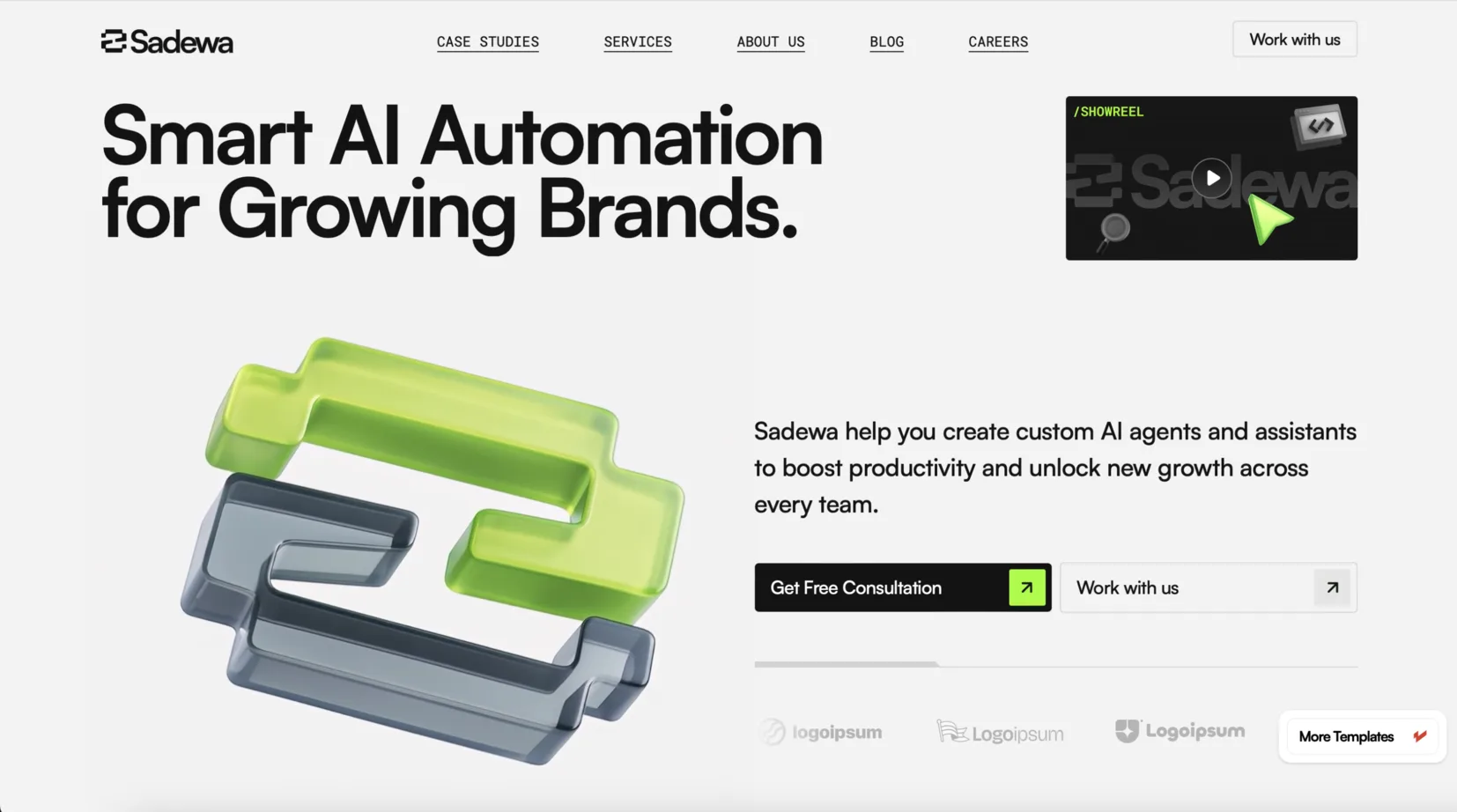
09Sadewa — best light and approachable design
Sadewa offers a lighter, more approachable alternative to the dark interfaces common in AI templates. Its 12 listed pages cover Home, case studies, About, contact, blog, careers, waitlist, legal and utility content.
This is a sensible structure for an early-stage team that wants to look credible, publish insights and recruit. It does not list dedicated services, service-detail or pricing pages, so an agency with several offers will need to extend the system.
Strengths
- Distinctive light and friendly visual direction
- Case studies, blog, About, contact and careers content
- Waitlist and legal pages included
- Good balance of proof and company credibility
Limitations
- No dedicated services or pricing pages are listed
- Only case-study and blog CMS templates are explicitly confirmed
- Less suitable for a large or highly segmented service catalogue
Best for:
New AI agencies, approachable B2B brands and small teams that want a lighter alternative to the typical dark AI aesthetic.
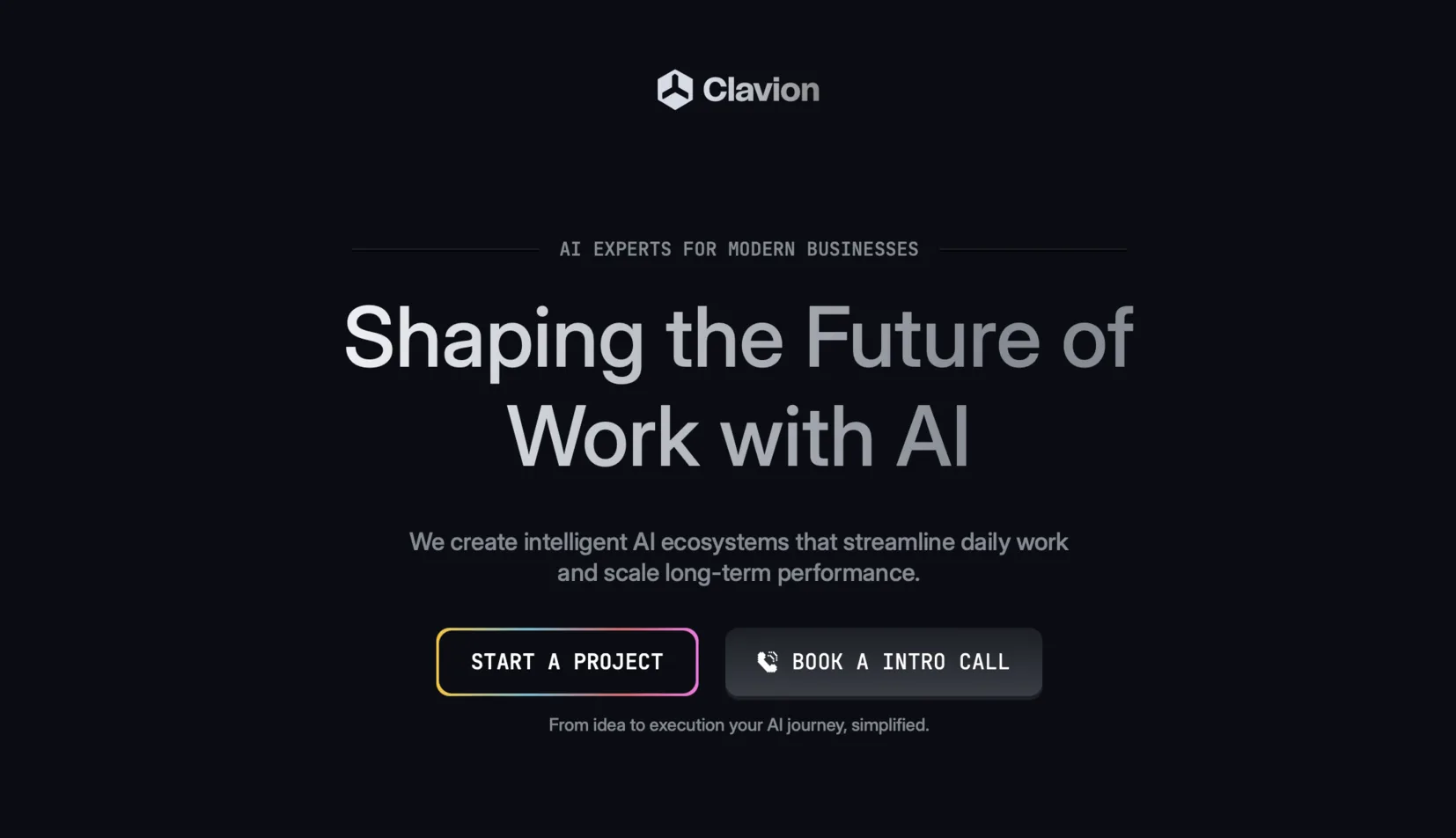
10Clavion — best focused B2B implementation site
Clavion is built around the questions a business buyer asks before an AI implementation project: what the agency delivers, how the work is executed and what evidence supports the offer. Its homepage includes service breakdowns, a structured delivery process, case-study signals, metrics and repeated conversion points.
The 12-page structure is relatively lean, with CMS used for case studies and blog content. The main compromise is that the listing does not include dedicated service-detail or pricing pages, limiting its SEO and sales depth out of the box.
Strengths
- Clear B2B AI implementation positioning
- Strong process, proof and conversion structure
- CMS support for case studies and insights
- Focused scope and accessible price
- GSAP interactions and performance-focused build
Limitations
- No dedicated service-detail or pricing pages are listed
- Smaller content system than the top multi-page options
- Bold dark presentation may need adaptation for conservative industries
Best for:
AI systems integrators, implementation teams and workflow-automation firms that want a focused technical website.
How to choose the right template
Start with your sales model, not the visual style
An attractive homepage is easy to notice, but page structure determines whether the template will support the business. List the pages you actually need before comparing colors and animations.
For most AI automation agencies, the minimum useful structure is:
- Home
- Services overview
- Individual service pages
- Case studies and case-study detail pages
- About or team
- Process
- Insights or blog
- Contact or enquiry
- Privacy and utility pages
If a template lacks two or three of those elements, estimate the time and cost of building them before treating the lower purchase price as a saving.
Match the CMS to your growth plan
Choose a CMS-powered services collection if you plan to create pages for separate capabilities or industries. Choose case-study CMS if proof is central to the sale. Choose a blog CMS if organic search and educational content are part of your acquisition strategy.
A generic blog collection does not replace a structured services or case-study system. Each content type should have fields and a layout suited to its job.
Review the template with real content
Replace at least one sample service, case study and homepage headline before committing. AI template demos often use short, abstract copy; real offers may need longer headings, detailed diagrams, legal explanations or technical screenshots.
Check what you will remove
More pages do not automatically mean more value. Ecommerce, user accounts and multiple homepage variants are useful only when they support the launch. Otherwise, they create additional decisions and may influence the Webflow Site plan you need.
Test the responsive preview
Open the official Webflow preview at desktop, tablet and mobile widths. Pay particular attention to navigation, pricing tables, case-study grids, forms and motion. A template should remain clear when the demo copy is replaced with your real content.
Template or custom website?
A Webflow template is usually the better choice when your business model is established, the required pages are conventional and speed matters. It can remove weeks of visual design and development while leaving room to customize brand, content and CMS data.
A custom website becomes more valuable when the website itself must explain a proprietary method, support an unusual conversion flow or connect deeply with a product experience. It may also be the right choice if every suitable template would require major structural changes.
Choose a template when…
- You need to launch in days or weeks
- Your offers fit a standard service-agency journey
- You have a limited design and development budget
- You want your team to manage content in Webflow CMS
- A suitable design already matches your brand direction
Choose custom when…
- Your positioning requires a unique information architecture
- You need custom calculators, tools or product interactions
- The website is a central product or competitive advantage
- Most template pages would need to be rebuilt
- You need a distinctive visual system that cannot be reached through customization
The middle ground is template customization: keep the proven CMS and responsive foundation, then adapt the copy, visual direction, sections and conversion flow to the business.
Frequently asked questions
What is the best Webflow template for an AI automation agency?
Automately is the strongest all-round choice for a service-based AI automation agency because it includes dedicated Services, Case Studies and Blog CMS collections, pricing, proof and enquiry pages without requiring ecommerce. Melville is better for a larger agency that wants the maximum number of layouts and content types.
How much do AI agency Webflow templates cost?
The templates in this comparison cost between $79 and $129 as of August 27, 2026. The purchase price does not include a paid Webflow Site plan, domain registration or third-party automation and booking tools.
Do I need Webflow development experience to use a template?
Basic content and style changes can be made visually in Webflow. More extensive changes — such as restructuring CMS collections, creating new responsive layouts or adding custom interactions — may require an experienced Webflow designer or developer.
Can I add an AI agency template to an existing Webflow project?
No. Webflow templates are used to create a new project rather than being applied to an existing one. Existing content and integrations may need to be migrated into the new template project.
Which pages should an AI automation agency website include?
At minimum, include Home, Services, service-detail pages, Case Studies, About, Process, Insights and Contact. Pricing guidance, industry pages, FAQs and individual team profiles can strengthen the site when they support the way clients evaluate your services.
Is a one-page template enough for a new AI agency?
It can be enough to validate a focused offer, especially for a solo consultant. A multi-page structure becomes more useful when you offer several services, need case studies, plan to publish SEO content or sell to buyers who require more proof before enquiring.
Can these templates rank in Google and AI search?
A template can provide a responsive and semantically organized foundation, but rankings depend on the finished site. Clear service pages, original case studies, useful expert content, descriptive titles, internal links, structured data, accessible images and credible authorship matter more than the demo design alone.
Do I need a CMS Site plan?
You will need a Webflow plan that supports CMS content if you keep the template’s dynamic collections. If you remove all CMS content and connections, a simpler plan may be possible, but that removes much of the value of templates built around services, case studies and articles.